How Does a Period Underwear Manufacturer Improve Wearing Comfort?
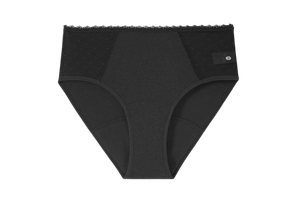
A comfortable pair of period underwear depends on more than softness. A manufacturer has to balance moisture transfer, absorbency, heat, stretch, seam pressure, gusset thickness, and wash durability within a garment that may be worn for 6–12 hours. A useful development program tests at least 3 fabric combinations, several liquid loads, and 20–30 wearers across different sizes instead of judging one prototype on a dress form. AATCC methods such as TM79-2025 for absorbency, TM204-2025 for water-vapor transmission, and TM217-2025 for vertical and horizontal wicking give manufacturers measurable ways to compare materials. Comfort improves when protection is achieved with less retained surface moisture, less bulk, and stable fit.
A period underwear manufacturer normally starts with the fabric touching the skin because the first few minutes after menstrual fluid reaches the gusset strongly affect how wet the garment feels. Softness alone is not enough. A fabric can feel smooth when dry but become sticky after absorbing moisture, while another fabric can move liquid into the next layer before the wearer notices much surface wetness.
For development, the top layer can be screened for at least four properties: initial wetting, horizontal spread, vertical transfer, and drying behavior. AATCC TM195 measures liquid moisture-management properties in knitted, woven, and nonwoven fabrics, while TM217-2025 measures how liquid spreads through and across fabric. Those methods are more useful than relying on supplier claims such as “quick dry” because two fabrics with similar fiber labels can behave differently after knitting, dyeing, and finishing.
A practical comparison might use 3 candidate inner fabrics, 5 specimens from each fabric, and the same liquid dose under the same conditioning environment. The manufacturer can then remove materials that wet slowly or keep too much moisture on the skin-facing side before making full garments.
Once the top layer transfers liquid efficiently, the absorbent section has to store that liquid without becoming unnecessarily thick. Period underwear often uses several functional materials because one material rarely performs acquisition, distribution, storage, and leak resistance equally well.
A development team may compare a 3-layer and 4-layer gusset at equal dimensions rather than assuming the thicker option will perform better. If the extra layer increases thickness by 20% but adds only a small amount of useful storage, the wearer receives more bulk without a proportional improvement in use time. The more useful measurement is absorbency per unit area and per millimeter of finished thickness.
| Property checked | Why it affects comfort | Example development check |
|---|---|---|
| Surface wetness | Damp fabric stays against sensitive skin | Compare rewet after several liquid doses |
| Gusset thickness | More thickness can be felt while walking or sitting | Measure before and after saturation |
| Liquid spread | Poor spread overloads one small area | Compare wet area after equal doses |
| Drying behavior | Slow drying can extend dampness | Compare identical specimens by mass loss |
| Flexibility | A stiff core moves differently from underwear fabric | Bend and wear-test dry and wet samples |
The table also shows why total absorption capacity should not be the only number shown on a product specification. A garment holding 30 mL is not automatically more comfortable than one holding 20 mL. If much of that 30 mL remains concentrated in a small area, local thickness and wetness can rise faster.
Moisture storage then leads directly to thermal comfort. The gusset combines body heat, limited airflow, liquid, and several layers of textile, so a waterproof barrier that performs well against leakage can still make the garment feel warm if water vapor passes through it slowly.
AATCC TM204-2025 is intended for measuring water-vapor transmission in textiles. Manufacturers can use that type of test alongside hydrostatic or leakage testing because the two requirements are different: one asks whether liquid gets through, while the other examines moisture-vapor movement. AATCC also lists TM208 for hydrostatic-pressure resistance, giving development teams separate ways to evaluate barrier performance and breathability.
More barrier material is not automatically better. If a leak-resistant film extends well beyond the area that normally receives fluid, the garment may retain more heat without improving protection. Pattern engineers can instead place the barrier where coverage is required and keep surrounding areas lighter.
The same approach applies to gusset geometry. A daytime bikini, a high-waist style, and overnight underwear should not use exactly the same absorbent panel. Body position changes when a person sits or lies down, and fluid may reach farther toward the back during sleep.
For an overnight prototype, a manufacturer might extend rear coverage by 40–70 mm compared with a daytime version, then check whether the added section stays flat during movement. The number is a development range rather than a universal requirement; final dimensions should come from fittings, leak-location records, and wearer feedback.
A useful wear study can involve 24 participants spread across several sizes, with each person recording comfort after 2, 4, 6, and 8 hours. Comments such as “too wide between the legs” or “moves backward while walking” become more useful when they are connected to measured gusset width, rise length, elastic tension, and garment size.
That wearer feedback naturally leads to fit. Period underwear has less tolerance for poor fit than ordinary underwear because the absorbent section has to remain in a predictable position. A loose leg opening can allow movement or side leakage, while excessive elastic tension can create pressure and visible marks.
Instead of fitting only one medium sample, a manufacturer can conduct size-set fittings at the lower, middle, and upper ends of a 6-size range. The team can measure waist circumference, hip circumference, front rise, back rise, leg opening, and gusset position after the garment has been worn for 30–60 minutes.
Elastic deserves separate attention because stretch percentage at sewing affects both security and pressure. Two elastics with the same width can feel different because their extension and recovery are not identical. A sample room should therefore record elastic type, cut length, attachment length, and sewing method rather than writing only “10 mm elastic” on the specification sheet.
Fit problems can also come from seams. The transition between a multilayer gusset and a lighter body fabric may create a raised edge, especially when several seam allowances meet at the same point. During 8 hours of wear, a small ridge can become more noticeable because it repeatedly contacts the inner thigh.
Flat construction, controlled seam allowance, softer thread, and carefully placed joins can reduce that contact. Bonding may remove some stitching, but bonded areas still need repeated wash checks because adhesive performance depends on temperature, detergent, material surface, and construction.
A seam that feels smooth on a new sample should be checked again after 10, 20, and 30 wash cycles. Comfort is a reusable-product requirement, not a first-wear requirement.
Repeated laundering can change several parts of the garment at once. The body fabric may shrink, the absorbent core may become firmer, the waterproof layer may crease, and elastic recovery may decrease. Even small dimensional changes can move the gusset away from its intended position.
AATCC maintains separate procedures for laundering, dimensional change, absorbency, drying, moisture management, and textile hand. TM79-2025 covers absorbency, TM199 evaluates drying time with a moisture-analyzer method, TM200 evaluates drying rate at absorbent capacity under airflow, and TM202 addresses relative hand value. Using several measurements gives a more complete view than repeating one absorbency test after washing.
A reasonable internal validation program can compare measurements at 0, 10, 30, and 50 washes. If waist recovery drops noticeably at 30 washes, the factory can review elastic specification. If drying time rises while absorbency remains similar, the absorbent structure or finishing process may need review. If shrinkage changes where the gusset sits, pattern compensation may be required.
Material selection also needs to account for fiber blend rather than marketing language. Cotton can provide a familiar hand, cellulosic fibers such as modal can produce a smooth surface, and synthetic fibers can be useful for liquid transfer and shorter drying times. Elastane is commonly introduced where stretch and recovery are required, but higher stretch content does not guarantee a better garment if fabric construction is unstable.
A manufacturer can compare 3 knitted fabrics with similar weight but different fiber combinations and test them before choosing one. Fabric weight should be recorded in g/m², stretch in both directions, recovery after extension, shrinkage after washing, surface appearance, and moisture behavior. A 10% change in fabric weight can be noticeable when several layers overlap in the gusset.
Material records should continue into bulk production. Roll-to-roll variation in width, weight, stretch, or finishing can change how the final underwear fits even when the sewing pattern has not changed. Incoming inspection can therefore check several rolls from each lot instead of approving fabric from one swatch.
Production control follows from material control. If gusset placement differs by 10–15 mm from one garment to another, the protection zone may sit differently on the body. If elastic attachment length varies, two garments labeled the same size may produce different pressure around the leg.
Factories can control these differences with measurement tolerances, first-piece approval, in-line checks, and finished-garment measurement. A sampling plan might inspect 32 pieces from a production lot for measurements and construction, while functional samples are retained for liquid and wash tests according to the buyer’s specification.
Comfort therefore has to be treated as a measurable garment property. A reliable development file should contain fabric specifications, layer construction, gusset dimensions, elastic data, seam construction, absorbency results, moisture-management results, wash results, and wearer comments linked to sample versions.
When version A, B, and C are compared against the same criteria, changes become easier to judge. A thinner version may reduce bulk by 15%, for example, but it should not be approved unless leakage, surface wetness, fit stability, and wash performance remain within the required range. That method gives brands and manufacturers a repeatable way to improve comfort while keeping menstrual protection consistent.