Questions Importers Can Ask About Reviewing factory capacity and production records
Factory capacity is a schedule claim that should be tested against real production records, bottlenecks, staffing, materials, yield, and inspection. Buyers can convert evidence into milestones and monitoring controls for a specific order.
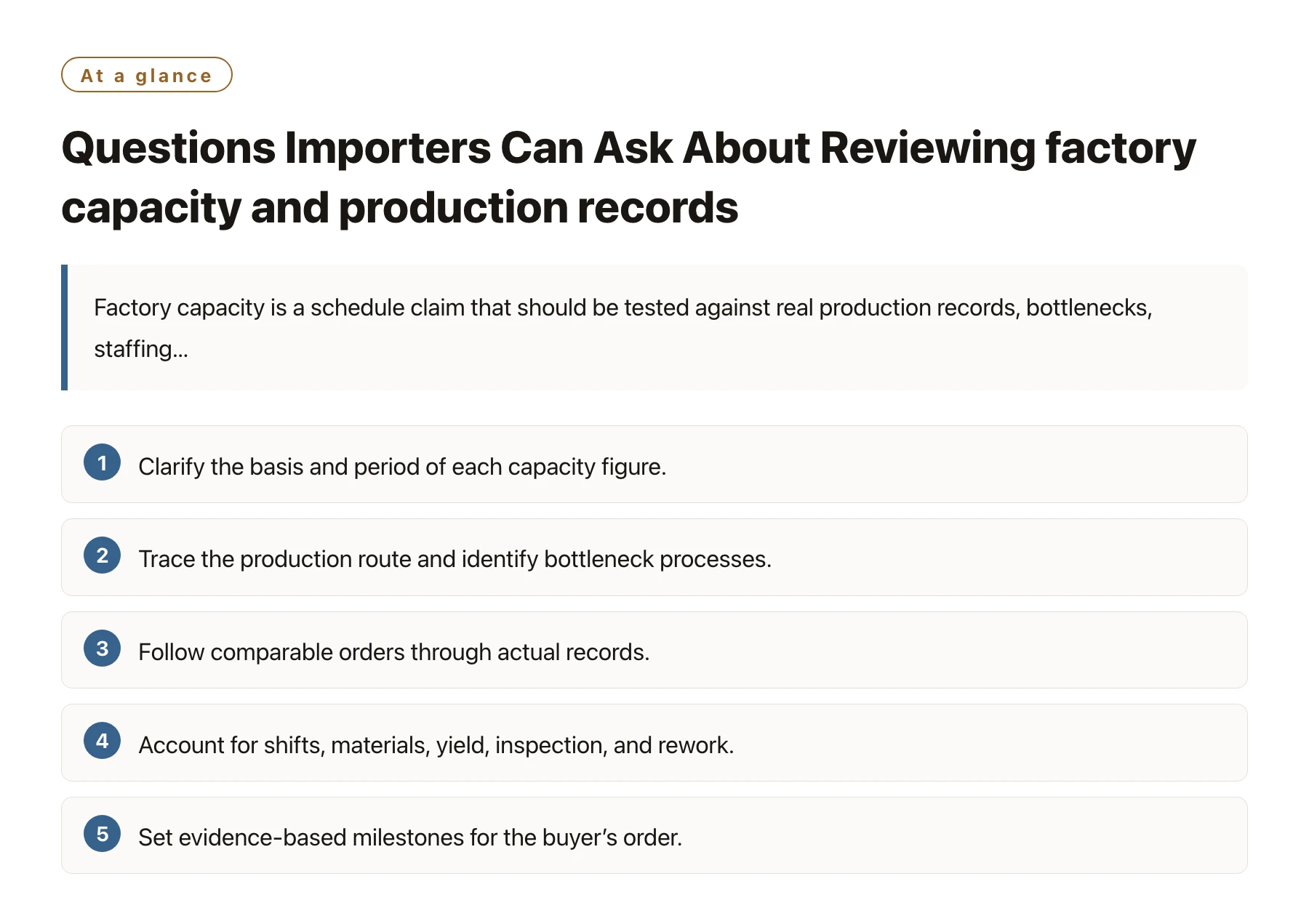
Key takeaways
- Clarify the basis and period of each capacity figure.
- Trace the production route and identify bottleneck processes.
- Follow comparable orders through actual records.
- Account for shifts, materials, yield, inspection, and rework.
- Set evidence-based milestones for the buyer’s order.
A capacity statement matters only when it connects to available resources, conforming output, and a realistic schedule for the exact product mix.
1. Which capacity figure is being quoted?
Ask whether a supplier’s number describes theoretical machine output, installed nameplate capacity, planned shift capacity, or output available for the buyer’s order. These figures are not interchangeable. Request the unit of measure, product mix, period, assumptions, and supporting records for every capacity statement.
Clarify whether quoted capacity includes setup, changeovers, maintenance, inspection, rework, and downtime. A high daily rate under a single-product continuous run may not apply to an order with several variants or tight acceptance criteria. Record the figure that matters to the project and how it will be monitored.
2. Map the production route and bottlenecks
Trace the order through material receipt, cutting or forming, assembly, finishing, inspection, packing, and dispatch. Identify which steps constrain throughput, require skilled operators, or rely on one machine, tool, or subcontractor. Ask the factory to map the proposed route for the actual product rather than a generic facility flow.
Check where work queues form and whether intermediate inventory is tracked. If a critical process is external, include transport and scheduling time in the plan. A factory may have spare assembly capacity but still miss the ship date if one outsourced finish or long-lead component is unavailable.
3. Review recent production records
Request dated records for recent comparable production: work orders, travelers, shift plans, output, inspection results, downtime, rework, and shipment quantities. Redact other customers’ confidential details while preserving the fields needed to understand the process. Check the period covered and whether records come from the named site.
Select a representative order and follow it across records from release to packing. Match product revision, quantity, lot, dates, work center, inspection status, and shipment identifier. Record missing links or unclear codes as evidence gaps rather than inferring that the process is controlled.
4. Test the schedule assumptions
Ask for a project schedule that separates drawing approval, materials, fabrication, assembly, software or finishing, testing, packing, and dispatch. Record duration, predecessor, owner, and evidence for each milestone. Confirm whether supplier lead time begins at deposit, final drawing approval, material release, or another trigger.
Compare the proposed schedule with recent actual completion records for similar work. Look for repeated slippage, long queues, and optimistic assumptions about weekends or shifts. Ask what buffer exists for quality findings and which recovery actions are realistic if a milestone slips.
5. Check staffing and shift coverage
Review operator availability, skill requirements, training records, supervisors, quality staff, maintenance support, and shift pattern for the relevant work centers. Ask how vacancies, turnover, overtime, seasonal demand, and holidays affect the order. Identify work that depends on one experienced technician or customer-specific programmer.
Where a second shift is proposed, confirm that supervision, tooling, process instructions, and inspection coverage are comparable. The existence of a night shift does not automatically mean it can run the same mix at the same yield. Ask for output and quality records by shift when schedule assumptions depend on that capacity.
6. Evaluate materials and supplier dependencies
Review critical material suppliers, lead times, minimum order quantities, safety stock, incoming checks, and alternative sources. Ask which items are already purchased for this order and what evidence confirms availability. Confirm that substitutions require buyer review when they affect specification, performance, finish, or documentation.
Map dependencies shared with other customers or product lines. A factory can have free machine time while a common component is allocated elsewhere. Ask how material status is linked to the production schedule and who escalates shortages before they become late-stage surprises.
7. Compare planned and actual yield
Request output and scrap data for comparable jobs where available. Clarify definitions: gross units started, good units passed, rework, scrap, and shipped quantity. A schedule based on gross production may understate the time needed to deliver the contracted conforming quantity.
For a new product, ask what pilot or first-article results underpin the yield assumption and how uncertainty is handled. Define when the supplier reports yield variance and whether additional material or time is required. Do not treat a target yield as historical evidence unless records support it.
8. Review inspection and release records
Check how in-process and final inspection are scheduled against production volume. Request sample plans, measurement reports, hold records, corrective actions, and release authorization. Trace one defect from detection through containment and closure to see how long rework affects output.
Confirm that inspection results identify lot, model, specification revision, date, and inspector. If the supplier uses an outside laboratory or inspection company, identify who reviews the result and blocks release when evidence is incomplete. Capacity should be understood as conforming output, not only items moving through the line.
9. Distinguish evidence from claims
The U.S. Department of Commerce recommends due diligence when evaluating foreign business partners. Use a proportionate review of factory identity, capacity claims, references, and records. Note whether information is directly observed, documented, stated in an interview, or still unverified. [1]
When a record is unavailable, decide what alternative evidence can answer the question: live line observation, system export, independent visit, purchase receipt, or reference check. Document limitations and their effect on the order decision. A supplier’s willingness to explain a gap is useful, but does not itself close it.
10. Turn the review into monitoring controls
Set order milestones for material readiness, production start, first-off approval, output review, inspection, packing, and release. Define the evidence and reporting frequency required at each gate. Assign the buyer a contact and an escalation route for material changes or schedule risk.
Teams arranging factory inspection in China can use a records-based capacity review to distinguish installed capability from committed output. Confirm the production site and schedule basis before award, then compare actual progress and conforming quantities against the same baseline.
Sources
Frequently asked questions
What records help verify factory capacity?
Review recent work orders, output and yield, staffing and shift plans, downtime, bottleneck schedules, inspection results, and shipment records.
Is machine nameplate capacity a reliable delivery estimate?
No. It excludes mix, changeovers, labor, quality yield, materials, maintenance, and competing orders unless those are explicitly included.
How can I tell whether a production schedule is realistic?
Compare each milestone and assumption with recent records for similar products, and identify dependencies, buffers, and recovery actions.
Why review quality records during a capacity assessment?
Capacity matters only when it produces conforming goods; inspection and rework can materially affect available output and lead time.